5. THE CONSTITUTION OF MAN
The astounding practical materialism to which we have been reduced in this country can hardly be more clearly shown than it is by the expressions that we employ in common life. We speak quite ordinarily of man as having a soul, of “saving” our souls, and so on, evidently regarding the physical body as the real man and the soul as a mere appanage, a vague something to be considered as property of the body.
With an idea so little defined as this, it can hardly be a matter of surprise that many people go a little further along the same lines, and doubt whether this vague something exists at all. So it would seem that the ordinary man is very often quite uncertain whether he possesses a soul or not; still less does he know that the soul is immortal. That he should remain in this pitiable condition of ignorance seems strange, for there is a very great deal of evidence available even in the outer world, to show that man has an existence quite apart from his body, capable of being carried on at a distance from it while it is living, and entirely without it when it is dead.
Until we have entirely rid ourselves of this extraordinary delusion that the body is the man, it is quite impossible that we should at all appreciate the real facts of the case. A little investigation immediately shows us that the body is only a vehicle by means of which the man manifests himself in connection with this particular type of gross matter out of which our visible world is built.
Furthermore, it shows that other and subtler types of matter exist – not only the ether admitted by modern science as interpenetrating all known substances, but other types of matter which interpenetrate ether in turn, and are as much finer than ether as it is than solid matter.
The question will naturally occur to the reader as to how it will be possible for man to become conscious of the existence of types of matter so wonderfully fine, so minutely subdivided. The answer is that he can become conscious of them in the same way as he becomes conscious of the lower matter – by receiving vibrations from them.
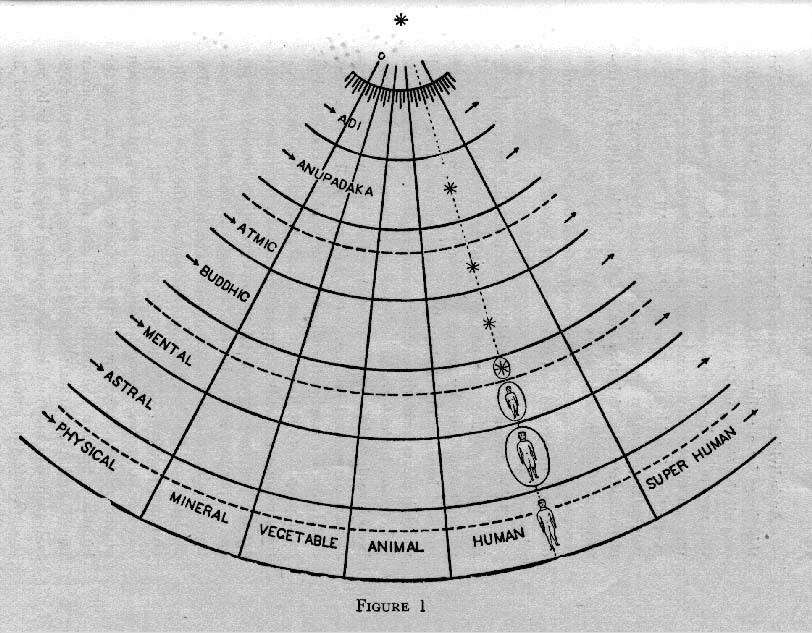
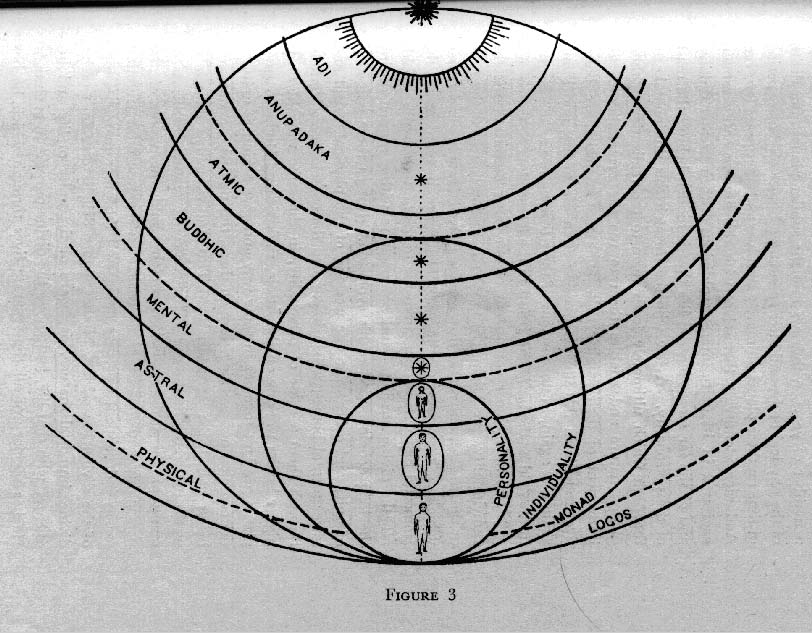
At this point in the text of Mr. Leadbeater’s work, which we are adapting as an introduction to the Perennial Philosophy, it seems appropriate to insert a few paragraphs from Chapter 7 of our own book, Theosophy, the Law of Universal Brotherhood and World Problems. This is particularly relevant given the diagrams taken from Dr. I.K. Taimni’s work (Self-Culture in the Light of Occultism), which illustrate the planes of nature and the vehicles of the human being:
[Beginning of the inserted paragraphs]
VII – THE PERENNIAL PHILOSOPHY AND THE LAW OF UNIVERSAL BROTHERHOOD:
The Diversity of the Manifested Capacities
“But this Brotherhood of all souls is like the relation of brotherhood within a family; brothers are not all of the same age, though they are of the same parents.” (C. Jinarajadasa, Practical Theosophy, p. 63; emphasis added)
“That great principle or law of Reincarnation must ever go hand in hand with the principle of Brotherhood if Brotherhood is to be applied, if it is to be made a working principle of ordinary life. For it is out of these differences of age that grows up all the possibilities of an ordered and happy society amongst ourselves.” (A. Besant, The Changing World, p. 79; emphasis added)
Let us now proceed to analyze Diversity, which co-exists with Unity and is also a fundamental aspect of the universal brotherhood of humanity. In spite of this, its importance within this law is not really as well known as that of the aspect of essential Unity. In this, as we hope to show, lies the origin of most of the incorrect interpretations within the TS concerning the law of the universal brotherhood, as well as the inability of most of the members to really understand its immense importance to the solutions of human problems. And it is because of this that we shall insist on the analysis of this aspect.
The Inner Constitution of Man
It is not possible for us to reach an exact understanding of the fundamental importance of this aspect (of the manifested Diversity) to the principle or law of the brotherhood of all humanity without taking into account the knowledge of the inner constitution of man or the evolutionary process of the human Soul through successive reincarnations. In this sense, the first fact of importance for an appropriate view of the human being as a whole which is revealed to us by the Perennial Philosophy is that of the existence of matter on many levels of density more subtle than those that are well known scientifically.
The important fact to our study is that man possesses bodies manifested on all these planes, even though, in accordance with his level of evolution, some may be quite underdeveloped. Thus, the human being is essentially a Ray or Spark of the Sun of the One Divine Consciousness, rooted in the highest or divine plane. From this point on, this Divine Consciousness in man covers itself with the body appropriate to its expression on all planes and sub-planes of density of matter, including the physical.
In accordance with the Perennial (or Esoteric) Philosophy, if we observe all of the constitution of man, from its densest to its most subtle body, it would be as follows: (1) a physical dense body, of flesh and bone, which corresponds to the solid, liquid and gaseous levels of the physical plane; (2) a first invisible body or aura, called etheric double, which belongs to the four etheric sublevels of the physical plane; (3) an astral or emotional (body or aura), made up of matter from the seven sublevels of the astral plane; (4) a concrete mental body made up of matter from the four densest mental sublevels; (5) an abstract mental body made up of matter from the three sublevels of more subtle mental matter; (6) an intuitive or buddhic body with matter from all sublevels of this plane; (7) a body of spiritual or atmic volition made up of matter from the four inferior sublevels of the atmic plane; (8) a Monad or Divine Spark, the reflection from the Divine Trinity in man, which is expressed beginning with the three higher atmic sublevels, up to the heights of the divine plan.
According to St. Paul’s well-known classification, the human being is composed of a body, a soul, and a spirit. Analogously, according to the Esoteric Philosophy, man is inhabited by a transitory personality (from the Greek, persona = mask), an immortal Ego, and a Divine Spirit. This personality is made up of the lower quaternary (the composition formed by the dense physical body, the etheric double, and the astral and mental bodies), which perishes, or renews itself, at each new incarnation. The Higher Ego is made up of the Higher Triad (the composition formed by the Higher Mental or Causal, Buddhic, and Atmic bodies). This Ego is immortal and is a reflection or manifestation of the Monad or Divine Spirit of man, which is always one with the Divine.
The total constitution of man described above may be visualized more easily with the help of the figures below (pp. 9 and 23, in Dr. Taimni’s book, “Self-culture in the Light of Occultism”). In the context of this work we cannot go deeper into this fascinating knowledge of the inner constitution of man, which can be found in the books devoted to this subject, for instance, “Man and his Bodies” by Annie Besant, or “Man Visible and Invisible” by C.W. Leadbeater.
The Evolution of Man’s Higher Self
The next point to be considered is how these bodies behave in the process of successive reincarnations as this will grant us a better understanding of the principal aspect of Diversity in the human brotherhood, which is the fact that humanity is made up of beings of different ages or different stages of spiritual evolution. This is so because this process of reincarnations explains the different accumulation of experiences, which lies at the basis of the different levels of maturity or spiritual development of human beings.
In a first stage, the divine energies create and surround themselves with ever denser levels of matter until reaching the physical plane. From this point on, as has been mentioned previously, these energies animate the mineral, vegetable, animal, human, and super-human kingdoms until they return fully conscious to the bosom of the One Divinity. Human beings, therefore, have immediately behind them the animal kingdom from which they rose as beings who have acquired their own individuality through the act of liberating themselves from the limitations of group consciousness typical of animal instincts.
It is only at this point in evolution, at the beginning of the human stage, that man’s Higher Ego has become an individual spiritual entity, thus acquiring freedom of thought and a much higher consciousness of self than it had in the animal kingdom. This Higher Ego, however, has not yet developed its immense latent powers. It will gradually develop these powers as the human being passes through successive reincarnations.
At the beginning of each incarnation, the Higher Ego creates a new lower quaternary to enable it to gather more experiences on the Physical, Astral, and Lower Mental planes. The physical life is usually the shortest, although the most meaningful one as it is the only one during which the human being encounters all the bodies and, therefore, has greater independence and power to generate new causes and search for new experiences.
After having existed for years in the physical body, man arrives at the passage called death when he abandons the dense physical body and the etheric double, which are both worn out and no longer of service to garner more experiences, and departs for a life on the astral plane with the help of his astral body. This life normally lasts two or three times longer than physical life, and then this astral body is left behind in a second death, which is another passage to a life normally even longer on the lower mental plane. At the end of this cycle, the Higher Ego garners the results or lessons of the experiences lived through its lower quaternary on the three densest planes.
This is a simple description of the process through which the Higher Ego develops its infinite powers until it reaches a stage of maturity and perfection in which this cycle of reincarnations is no longer mandatory. In other words, at the end of this long journey through hundreds of reincarnations, the human being achieves Liberation, and his consciousness enters a super-human stage of development, one of whose characteristics is the fact of having achieved conscious immortality and the other is the unity with the Divine Will. One of the names given to this Liberation is that of “Adeptship.” The Adepts or Mahatmas who inspired the founding of the TS are believed to be examples of beings who have already achieved this evolutionary level.
All human beings are engaged in this process of development of their divine powers because, as has been stated previously, all are essentially divine. However, the billions of incarnate human beings, as well as those (in even larger numbers) without a physical body in the cyclical astral or mental life, will not start out on their human journey at the same time. Some of them have begun their journey long before others. Thus, while some have already arrived at their destination and others are nearing the end of their journey, the greater part of humanity can be found along this way, some of them even at its beginning. This is a very important fact as it explains the great diversity in stages of spiritual development (reflected in the differences of character and ability) in human beings.
In view of the above, it is not difficult for us to understand that this aspect of the great Diversity in the levels of spiritual development is almost as important in helping us understand the true nature of the universal brotherhood of humanity, as that of the Unity underlying all beings.
The Causal Body: the Only True Register of Evolution
Let us now consider some excerpts from the writings of Geoffrey Hodson, a great clairvoyant of the TS, in which he deals with the Higher Mental (Causal) body as well as with its development. These excerpts will clearly explain what has already been touched on in preceding paragraphs:
“In Sanskrit, the causal body is known as the Karana Sharira, Karana meaning cause. Briefly, the causal body has two main functions:
(1) To act as a vehicle for the ego: the causal body is the “body of Manas,” the form aspect of the individual, the true man, the Thinker.
(2) To act as a receptacle or storehouse for the essence of man’s experiences in his various incarnations. The causal body is that into which is woven everything which can endure, and in which are stored the germs of qualities, to be carried over to the next incarnation. Hence one sees that the lower manifestation of man, i.e., his expression in his mental, astral and physical bodies, depends ultimately upon the growth and development of the real man himself, the one “for whom the hour never strikes”.
At its inception, the causal body, or form-aspect of the true man, is described as a delicate film of subtlest matter, just visible, marking where the individual begins his separate life. That delicate, almost colourless, film of subtlest matter, is the body which will last through the whole of the human evolution: on this, as on a thread – the thread-self, or Sutratma, as it is sometimes called – will all the future incarnations be strung.
The causal body, as said, is the receptacle of all that is enduring – i.e., only that which is noble and harmonious, and in accordance with the law of the spirit; for every great and noble thought, every pure and lofty emotion, is carried up, and its essence worked into the substance of the causal body. Hence, the conditions of the causal body is a true register – the only true register – of the growth the man, of the stage of evolution to which he has attained. (…)
In the Thinker, residing in the causal body, are all the powers that we class as Mind, i.e., memory, intuition, will, the Thinker gathers up all experiences of the earth-lives, through which he passes, to be transmuted within himself, by his own divine alchemy, into that essence of experience and knowledge which is Wisdom. Even in the one brief earth-life we distinguish between the knowledge we acquire and the wisdom we gradually – often too rarely – distil from that knowledge. Wisdom is the fruitage of life’s experience, the crowning possession of the aged. In a much fuller and richer sense, Wisdom is the fruitage of many incarnations, the produce of much experience and knowledge. In the Thinker, thus, is the store of experiences, reaped in all his past lives, harvested through many rebirths.
In ordinary people the causal body is not yet fully active, and consequently only that matter which belongs to the third sub-plane is vivified. As the ego, during the long course of his evolution, unfolds his latent possibilities, the higher matter is gradually brought into activity; but it is only in the perfected men whom we call Adepts, or Masters, that it is developed to its fuller extent.
It is difficult to describe a causal body fully, because the senses belonging to the causal world are altogether different from and higher than those we employ at the physical level. Such memory of the appearance of a causal body, as it is possible for a clairvoyant to bring into his physical brain, represents it as an ovoid, that being, in fact, the shape of all the bodies, and as surrounding the physical body of the man, extending to a distance of about 18 inches from the surface of the physical body.
A human being, who has just individualised from the animal kingdom, has a causal body of a minimum size.
In the case of a primitive man, the causal body resembles a bubble and gives the impression of being empty. It is a mere colourless film, just sufficient, apparently, to hold itself together and make a reincarnating entity, but no more. Although it is filled with higher mental matter, this is not yet brought into activity, and so remains colourless and transparent. As the man develops, this matter is gradually stirred into alertness by vibrations which reach it from the lower bodies. This comes but slowly, because the activities of man in the earlier stages of his evolution are not of a character to obtain expression in matter so fine as that of the causal body. But when a man reaches the stage where he is capable either of abstract thought, or of unselfish emotion, the matter of the causal body is aroused into response.
The vibrations thus aroused show themselves in the causal body as colours, so that, instead of being a mere transparent bubble, it gradually becomes a sphere filled with matter of the most lovely and delicate hues, an object beautiful beyond all conception.
In the case of spiritually developed man, an enormous change is noticed. The glorious iridescent film is now completely filled with the most lovely colours, typifying the higher form of love, devotion and symphathy, aided by an intellect refined and spiritualised, and by aspirations reaching ever towards the divine. Some of these colours have no place in the physical plane spectrum.
The inconceivably fine and delicate matter of such a causal body is intensively alive, and pulsating with living fire, forming a radiant globe of flashing colours, its high vibrations sending ripples of changing hues over its surface – hues of which earth knows nothing – brilliant, soft and luminous beyond the power of language to describe. Such a causal body is filled with living fire, drawn from a still higher plane, with which it appears to be connected by a quivering thread of intense light.
Furthermore, from the upper part of the causal body there ascends a crown of brilliant sparks, indicating the activity of spiritual aspiration, and of course adding very greatly to the beauty and dignity of the man’s appearance. (…)
This very upward rushing of spiritual aspiration, which makes so glorious a crown for the developed man, is itself the channel through which the divine power descends: so that the fuller and stronger his aspiration become, the larger is the measure of the grace from on high.” (Basic Theosophy, pp. 21-25; emphasis added)
Diversity Applied to Social Organization
The information given above makes it possible for us to understand how Diversity of levels of development is one of the fundamental aspects of human brotherhood, as is also its essential Unity. In the light of this knowledge we are then able to embark on a general visualization of the universal brotherhood of humanity as it is presented during earthly life. We shall do this through a quotation from C. Jinarajadasa, well-known author and former International President of the TS. In these paragraphs he states in simple language the fundamental aspects of human brotherhood, giving due emphasis not only to the aspect of Diversity but also to some of its principal practical implications, using as examples questions concerning government and the treatment of criminals:
“Since a man is a unit of a social organization, the value which any ethical teaching may have for the individual is inseparable from its application to the community of which he is a part. Just as an understanding of certain simple truths modifies a man’s conception of himself, so too the conception of what constitutes the true state, when viewed in the light of the Esoteric Philosophy, profoundly modifies a man’s attitude to his life among his fellow men. (…)
The individuals who compose the state are Souls, immortal egos in earthly bodies; they are the members of the State in order to evolve to an ideal of perfection. As souls, and as all partaking of one Divine Nature, all within the State are brothers; whether rich or poor, cultured or ignorant, law-abiding or law-breaking, all are brothers, and nothing one soul does can modify that fact of nature.
The educated or the proud may refuse to see an identity of nature with the ignorant and the lowly; the weak and the criminally minded may show more attributes of the brute than that of the God. Yet is there in high and low alike the one nature of the Divine Life, and nothing a man does can weaken the bond of brotherhood between him and all the others.
But this Brotherhood of all souls is like the relation of brotherhood within a family; brothers are not all of the same age, though they are of the same parents. So too, among the souls that compose a state, there are elder souls and younger souls; it is just this difference of spiritual age and capacity which makes possible the functions of the real State.
The age of the soul is seen in the response to ideals of altruism and co-operation; he is the elder soul who springs forward to help in the welfare of others, and that soul is the younger who thinks of self-interest first and follows its needs in preference to self-sacrifice on behalf of others.
The divisions which we now have in a state’s life of rank and of wealth are no true distinctions which divide the elder souls from the younger souls; one man born into a high class or caste may yet be a very young soul, while another whose birth is ignoble, according to the world’s conventions, may be far advanced as a soul.
There being in each state elder souls and younger souls, the Law of Brotherhood requires that the elder shall be more self-sacrificing, on behalf of the younger, than the younger should be towards the elder. Since life through long ages has given more to the elder souls than to the younger, more is required from the elder, both of self-sacrifice and of responsibility.
By the natural order of events, the direction of a state’s affairs will fall inevitably on the elder souls. (…) when the state begins to perform its true functions, the direction of its affairs is by an aristocracy, by the best souls, that is, the elder and more capable souls. (…)
The great principle to guide them in their administration is that in all the state’s affairs the principle or law of Brotherhood shall dominate in all things.
This will mean the clear recognition that any preventable suffering or ignorance or backwardness of even one citizen is to the detriment of the welfare of all citizens; since the destiny of each is inseparable from the destiny of all, as rises one so rise all, and as falls one so fall all; that there must be no shadow of exploitation of one man by another, of one class or caste by another. Since, too, all men are souls and, even the least developed, Gods in the making, it becomes the duty of the administrator in all laws and institutions continually to appeal to the hidden Divinity in man. (…)
When there comes in the state the recognition of this hidden God in man, a complete revolution will take place in our attitude to and in our treatment of the criminal. First and foremost, whatever he does, he is our brother. He is a younger brother truly to those of us who are the elders and give implicit and willing obedience to the laws of the state; but though he falls a thousand times, he is our brother even after the thousandth time.” (Practical Theosophy, pp. 61-66; emphasis added)
These quotations from C. Jinarajadasa show the relevance of the aspect of Diversity to the universal brotherhood of humanity and reveal some of its major practical implications. Unfortunately, the importance of this aspect is not so well known in either theoretical or practical terms. The following quotation from N. Sri Ram is a clarion call in this direction:
“It is not enough to realize our underlying brotherhood, but there has to be skill and wisdom in dealing with the outer differences, the inequalities of development and circumstances.” (Thoughts for Aspirants, 2nd Series, p. 122; emphasis added)
The Importance of the Law of Reincarnation
There is a passage from the writings of HPB which is also worth mentioning in this context, in which she remarks on the importance of the law of reincarnation in explaining the differences in human beings and on the harm done by the lack of a logical explanation for these differences:
“Cultured people have been brought up in that most pernicious idea that the wide difference found between the units of one and the same mankind, or even race, is the result of chance; that the gulf between man and man in their respective social positions, birth, intellect, physical and mental capacities – every one of which qualifications has a direct influence on every human life – that all this is simply due to blind hazard, only the most pious among them finding equivocal consolation in the idea that this is ‘the will of God.’ They have never analysed, never stopped to think of the depth of the opprobrium that is thrown upon their God, once the grand and most equitable law of the manifold rebirths of man upon this earth is foolishly rejected.” (Collected Writings, Vol. XIV, p. 57; emphasis added)
[End of the paragraphs from the work Theosophy, the Law of Universal Brotherhood and the World Problems. Below continues the core text from the work by Mr. C.W. Leadbeater.]
And he is enabled to receive vibrations from them by reason of the fact that he possesses matter of these finer types as part of himself – that just as his body of dense matter is his vehicle for perceiving and communicating with the world of dense matter, so does the finer matter within him constitute for him a vehicle by means of which he can perceive and communicate with the world of finer matter which is imperceptible to the grosser physical senses.
This is by no means a new idea. It will be remembered that St. Paul remarks that “there is a natural body, and there is a spiritual body,” (man is a physical body, he is a psyche, and a spirit) [I Corinthians, 15:44] and that he furthermore refers to both the soul and the spirit in man, by no means employing the two synonymously, as is so often ignorantly done at the present day.
It speedily becomes evident that man is a far more complex being than is ordinarily supposed; that not only is he a spirit within a soul but that this soul has various vehicles of different degrees of density, the physical body being only one, and the lowest of them.
These various vehicles may all be described as bodies in relation to their respective levels of matter. It might be said that there exist around us a series of worlds one within the other (by inter-penetration), and that man possesses a body for each of these worlds, by means of which he may observe it and live in it.
He learns by degrees how to use these various bodies, and in that way gains a much more complete idea of the great complex world in which he lives; for all these other inner worlds are in reality still part of it.
In this way he comes to understand very many things which before seemed mysterious to him; he ceases to identify himself with his bodies, and learns that they are only vestures which he may put off and resume or change without being himself in the least affected thereby.
Once more we must repeat that all this by no means metaphysical speculation or pious opinion, but definite scientific fact thoroughly well known experimentally to those who have studied ans investigated the principles of the Perennial (or Esoteric) Philosophy.
Strange as it may seem to many to find precise statements taking the place of hypothesis upon questions such as these, I am speaking here of nothing that is not known by direct and constantly repeated observation to a large number of students. Assuredly “we know whereof we speak”, not by faith but by experiment, and therefore we speak with confidence.
To these inner worlds or different levels of nature we usually give the name of planes. We speak of the visible world as “the physical plane”, though under that name we include also the gases and various grades of ether.
To the next stage of materiality the name of “the astral plane” was given by the medieval alchemists (who were well aware of its existence), and we have adopted their title. Within this exists another world of still finer matter, of which we speak as “the mental plane”, because of its matter is composed what is commonly called the mind in man. There are other still higher planes, but I need not trouble the reader with designations for them, since we are at present dealing only with man’s manifestation in the lower worlds.
It must always be born in mind that all these worlds are in no way removed from us in space. In fact, they all occupy exactly the same space, and are all equally about us always. At the moment our consciousness is focused in and working through our physical brain, and thus we are conscious only of the physical world, and not even of the whole of that.
But we have only to learn to focus that consciousness in one of these higher vehicles, and at once the physical fades from our view, and we see instead the world of matter which corresponds to the vehicle used.
Recollect that all matter is in essence the same. Astral matter does not differ in its nature from physical matter any more than ice differs in its nature from steam. It is simply the same thing in a different condition. Physical matter may become astral, or astral may become mental, if only it be sufficiently subdivided, and caused to vibrate with the proper degree of rapidity.
The True Man
What, then is the true man? He is in truth an emanation from the Logos, a spark of the Divine fire. The spirit within him is of the very essence of the Deity, and that spirit wears his soul as a vesture – a vesture which encloses and individualises it, and seems to our limited vision to separate it for a time from the rest of the Divine Life.
The story of the original formation of the soul of man, and of the enfolding of the spirit within it, is a beautiful and interesting one, but too long for inclusion in a merely elementary work like this. It may be found in full detail in those of our books which deal with this part of the Perennial Philosophy.
Suffice it here to say that all three aspects of the Divine Life have their part in its inception, and that its formation is the culmination of that mighty sacrifice of the Logos in descending into matter, which has been called the Incarnation.
Thus the baby soul is born; and just as it is “made in the image of God” – threefold in aspect, as He is, and threefold in manifestation, as He is also – so is its method of evolution also a reflection of His descent into matter. The Divine Spark contains within it all potentiality, but it is only through long ages of evolution that all its possibilities can be realised.
The appointed method for the evolution of the man’s latent qualities seems to be by learning to vibrate in response to the impacts from without. But at the level where he finds himself (that of the higher mental plane) the vibrations are far too fine to awaken this response at present; he must begin with those that are coarser and stronger, and having awakened his dormant sensibilities by their means he will gradually grow more and more sensitive until he is capable of perfect response at all levels to all possible rates of vibration.
That is the material aspect of his progress; but regarded subjectively, to be able to respond to all vibrations means to be perfect in sympathy and compassion. And that is exactly the condition of the developed man –the adept, the spiritual teacher, the Christ. It needs the development within him of all the qualities which go to make up the perfect man; and this is the real work of his long life in matter. In this chapter we have brushed the surface of many subjects of extreme importance. Those who wish to study them further will find many books of the Perennial Philosophy to help them.
On the constitution of man, we would refer readers to Mrs. Besant’s works, Man and His Bodies, The Self and Its Sheaths, and The Seven Principles of Man, and, also my own book, Man, Visible and Invisible, in which will be found many illustrations of the different vehicles of man as they appear to the clairvoyant sight. On the use of the inner faculties refer to Clairvoyance.
On the formation and evolution of the soul to Mrs. Besant’s Birth and Evolution of the Soul, Mr. Sinnett’s Growth of the Soul, and my own Christian Creed and Man, Visible and Invisible.
On the spiritual evolution of man, Mrs. Besant’s In the Outer Court and The Path of Discipleship, and the concluding chapters of my own little book, Invisible Helpers.
NOTES
(1) Also read Self-Culture in the Light of Occultism, by I. K. Taimni; from which we copied the diagrams previously added to this introductory work.
(2) Also read The Mystery Schools by Clara Codd, and the Inner Life by C.W. Leadbeater.